

Circle has been accused of failing to act in the $280 million exploit
Drift investors accuse the stablecoin issuer of negligence and facilitating the conversion by allowing the conversion process to drag on for hours through CCTP.
4/18/20263 min read
The main allegations against Circle
Circle Internet Financial (NYSE: CRCL), the issuer of USDC, is currently the target of a proposed class-action lawsuit filed by investors in Drift Protocol who suffered losses of between $280 million and $285 million in the April 1, 2026 hack.
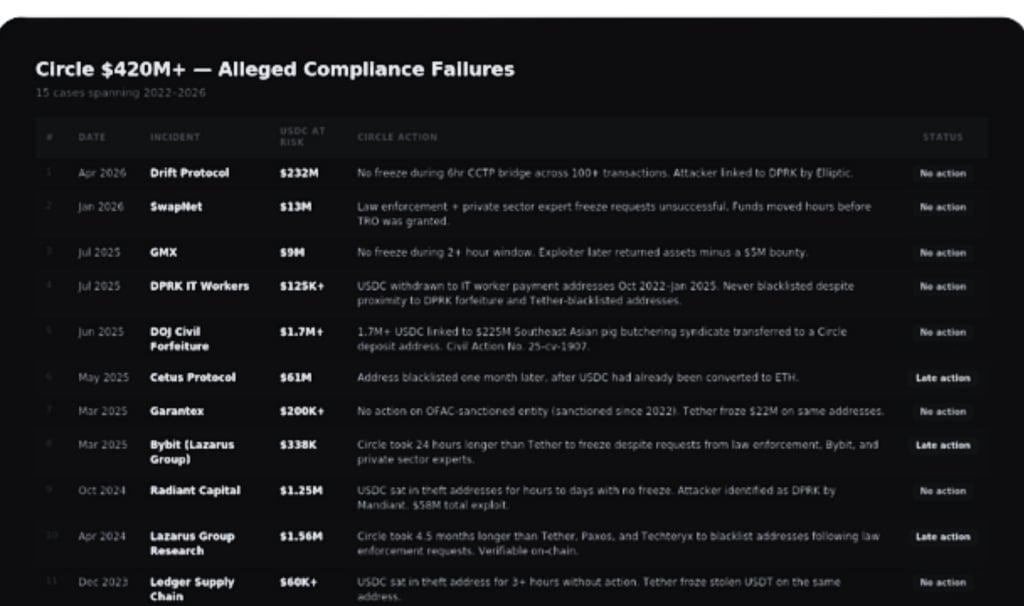
The lawsuit, filed on April 14 in the U.S. District Court in Massachusetts by plaintiff Joshua McCollum (representing more than 100 affected investors) and led by Gibbs Mura of A Law Group, alleges that Circle had both the technical capability and contractual authority to freeze the stolen USDC but failed to act when the attackers transferred approximately $230 million between chains using Circle's own Cross-Chain Transfer Protocol (CCTP).
The attackers (widely suspected of having ties to North Korea) converted a large portion of the stolen assets into USDC and then used Circle's CCTP bridge in over 100 transactions spanning several hours.
Circle had the ability to freeze the wallets involved (as demonstrated by previous freezes in other cases) but chose not to act without official instructions from law enforcement or the court.
This inaction is considered negligence and complicity in the misappropriation of stolen funds, allowing perpetrators to launder money and consolidate profits more effectively.
The lawsuit, seeking damages to be determined in court, has garnered attention as one of the first major class-action lawsuits targeting a stablecoin issuer's response to a high-profile DeFi hack. The lawsuit alleges that the losses “would not have occurred, or would have been significantly reduced,” if Circle had intervened during the hours when funds were being transferred from Solana to Ethereum.
Control problem
At the heart of the lawsuit is a technical fact: Circle has the ability, under certain conditions, to freeze USDC at the smart contract level. That ability creates a gray area. Although USDC operates on decentralized platforms, it still retains centralized control mechanisms that can be triggered in exceptional circumstances.
The lawsuit argues that this control entails liability. Circle's previous position that the interference risks undermining neutrality can now be examined in a legal rather than a philosophical context.
If the court determines that stablecoin issuers are obligated to act in cyberattacks, this could redefine legal liability across the entire DeFi sector, forcing issuers to exercise greater oversight and intervention, and blurring the lines between decentralized protocols and regulated financial services.
Examine the legal liability of stablecoin issuers
This lawsuit fuels debate about when and how publishers like Circle should exercise their freeze rights during ongoing attacks. Faster intervention may limit losses but carries the risk of legal repercussions, abuse of power, and erosion of trust in decentralized systems.
Although USDC maintained a fixed exchange rate throughout the Drift incident, continued public scrutiny could influence institutional and individual investor preferences between USDC and competitors like USDT, especially as Tether expands its consumer offerings (e.g., the recent launch of tether.wallet).
The lawsuit reinforces existing concerns about operational security (as seen in the Drift multi-signature breach) and cross-chain connectivity. It could spur calls for improved protocol-level safeguards, insurance funds, and a clearer regulatory framework for stablecoin issuers.
Our review
The class-action lawsuit against Circle highlights a core dilemma in the burgeoning stablecoin landscape: the balance between a rapid response to illicit activities and legal predictability and user protection. As USDC and other stablecoins become increasingly important in DeFi, payments, and tokenized assets, the lines of issuer liability in attacks are likely to be challenged more frequently.
Disclaimer: The information presented in this article is the author's personal opinion in the field of cryptocurrency. This is not financial or investment advice. All investment decisions should be based on careful consideration of your personal portfolio and risk tolerance. The views expressed in this article do not represent the official stance of the platform. We recommend that readers conduct their own research and consult with experts before making any investment decisions.
Compiled and analyzed by HCCVenture
Follow HCCVenture here: https://link3.to/holdcoincventure
Explore HCCVenture group
HCCVENTURE QUANT JSCO
© 2026 HCCVENTURE. ALL COPYRIGHTS RESERVED.


Connect with us
Popular content
Contact to us
Address: 8th Floor, Bach Dang Complex Building, 50 Bach Dang Street, Hai Chau Ward, Da Nang City, Vietnam.
Phone: 1900 1509
Gmail : sp_contact@hccventure.com
Disclaimer: The information on this website is for informational purposes only and should not be considered investment advice. We are not responsible for any risks or losses arising from investment decisions based on the content here.
TERMS AND CONDITIONS • CUSTOMER PROTECTION POLICY
ANALYTICAL AND NEWS CONTENT IS COMPILED AND PROVIDED BY EXPERTS IN THE FIELD OF DIGITAL FINANCE AND BLOCKCHAIN BELONGING TO HCCVENTURE ORGANIZATION, INCLUDING OWNERSHIP OF THE CONTENT.
RESPONSIBLE FOR MANAGING ALL CONTENT AND ANALYSIS: HCCVENTURE FOUNDER - TRUONG MINH HUY
Read warnings about scams and phishing emails — REPORT A PROBLEM WITH OUR SITE.