

Canada proposes a complete ban on political donations in the form of crypto
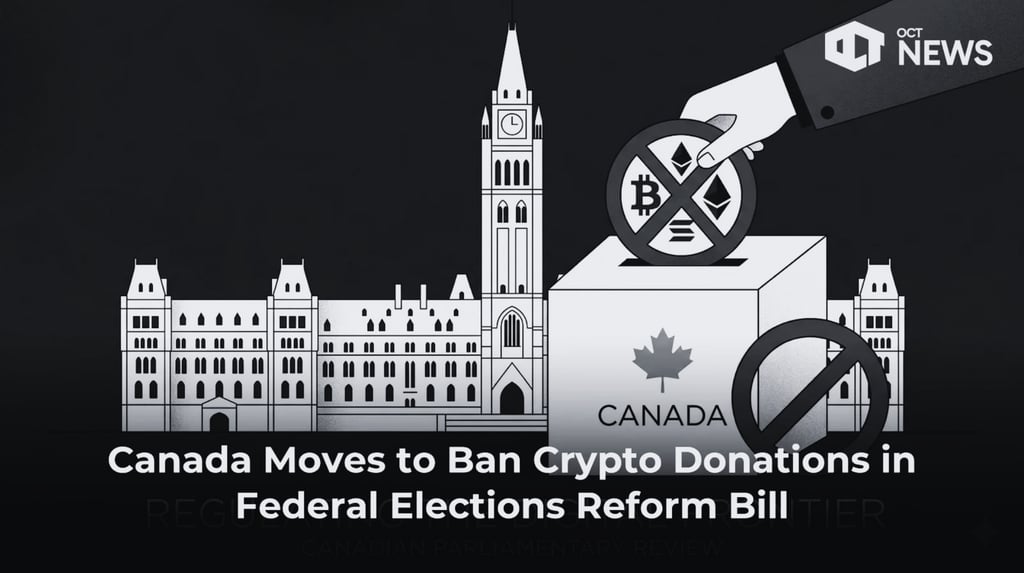
The Liberal federal government of Canada has officially introduced bill C-25, the Strong and Free Elections Act, proposing a comprehensive ban on cryptocurrency donations to political parties.
3/31/20262 min read

Tighten election regulations.
Canada is preparing to ban cryptocurrency donations across its entire political system, marking a decisive shift in how governments approach the link between digital assets and electoral integrity. This proposal, incorporated into the government's Strong and Free Elections Act, reflects growing concerns that the structural lack of transparency in cryptocurrencies could create new vulnerabilities in democratic processes.
If enacted, this measure would be broadly applied – including to political parties, candidates, leadership campaigns, and third-party advertisers – effectively eliminating cryptocurrency as a funding channel in federal elections.
Canada's move is noteworthy not because cryptocurrency donations are widely used, but because they were previously permitted under a regulated framework.
Since 2019, political donations in Bitcoin and other digital assets have been considered non-monetary donations, subject to disclosure requirements and conversion to fiat currency before use.
In reality, adoption remains very limited. Major federal parties have reported virtually no cryptocurrency donations in recent election cycles, suggesting the current proposal is more preventative than reactive.
However, the stance of regulators has become tougher. Canada's chief election officer is increasingly arguing that even with regulations on transparency, the semi-anonymous nature of cryptocurrencies makes verifying the true origin of funds difficult, especially in cross-border contexts.
Fixing the "hard-to-trace" vulnerability
According to the proposed amendments to the Canadian Elections Act:
Article 372.1 prohibits the principal representatives of registered parties, the financial representatives of associations, the official representatives of candidates, and the representatives of nominated/leading candidates from receiving contributions in the form of cryptocurrency.
Article 349.04 extends the prohibition to third parties engaging in partisan activities, election advertising, or polling.
Recipients must return any such contributions within 30 days of becoming aware of them, or face penalties.
The ban applies across the entire federal political ecosystem and is seen as part of broader safeguards: prohibiting foreign entities from donating to third parties for regulated activities, banning AI-generated fake videos of election figures, and strengthening enforcement powers.
Administrative monetary penalties will increase sharply to $25,000 for individuals and $100,000 for organizations, with additional violations potentially incurring fines double the value of the prohibited contribution.
House Majority Leader Steven MacKinnon, who sponsored the bill, linked the measure directly to protecting the integrity of the election: the law aims to "close potential channels for foreign funding" and address the risks highlighted in the Public Inquiry into Foreign Interference.
Our review
Bill C-25 is currently in its first reading in the House of Commons and must undergo committee review, a third reading, and Senate approval before becoming law. Considered essential election security legislation amid concerns about foreign interference, passage seems likely under the current minority government, although the timing may fall in the pre-election period. For the cryptocurrency industry, this is a reminder that political integration remains a double-edged sword: the very anonymity that enhances financial sovereignty raises concerns in the context of democratic accountability. However, Canada's move does not signal hostility toward the asset class itself, but rather a prudent exception to a narrow use case.
Disclaimer: The information presented in this article is the author's personal opinion in the field of cryptocurrency. This is not financial or investment advice. All investment decisions should be based on careful consideration of your personal portfolio and risk tolerance. The views expressed in this article do not represent the official position of the platform. We advise readers to conduct their own research and consult with experts before making any investment decisions.
Compiled and analyzed by HCC Venture
Follow HCCVenture here: https://link3.to/holdcoincventure
Explore HCCVenture group
HCCVENTURE QUANT JSCO
© 2026 HCCVENTURE. ALL COPYRIGHTS RESERVED.


Connect with us
Popular content
Contact to us
Address: 8th Floor, Bach Dang Complex Building, 50 Bach Dang Street, Hai Chau Ward, Da Nang City, Vietnam.
Phone: 1900 1509
Gmail : sp_contact@hccventure.com
Disclaimer: The information on this website is for informational purposes only and should not be considered investment advice. We are not responsible for any risks or losses arising from investment decisions based on the content here.
TERMS AND CONDITIONS • CUSTOMER PROTECTION POLICY
ANALYTICAL AND NEWS CONTENT IS COMPILED AND PROVIDED BY EXPERTS IN THE FIELD OF DIGITAL FINANCE AND BLOCKCHAIN BELONGING TO HCCVENTURE ORGANIZATION, INCLUDING OWNERSHIP OF THE CONTENT.
RESPONSIBLE FOR MANAGING ALL CONTENT AND ANALYSIS: HCCVENTURE FOUNDER - TRUONG MINH HUY
Read warnings about scams and phishing emails — REPORT A PROBLEM WITH OUR SITE.