

Buterin introduced a non-USD index to call for a reshaping of stablecoins
Vitalik Buterin has reignited the long-standing debate about stablecoin design, suggesting that the next generation of decentralized stablecoins should move beyond strict pegging to the USD, aiming for asset realism.
1/13/20262 min read
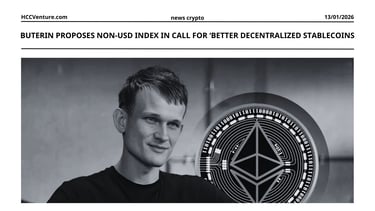
A new message from Buterin
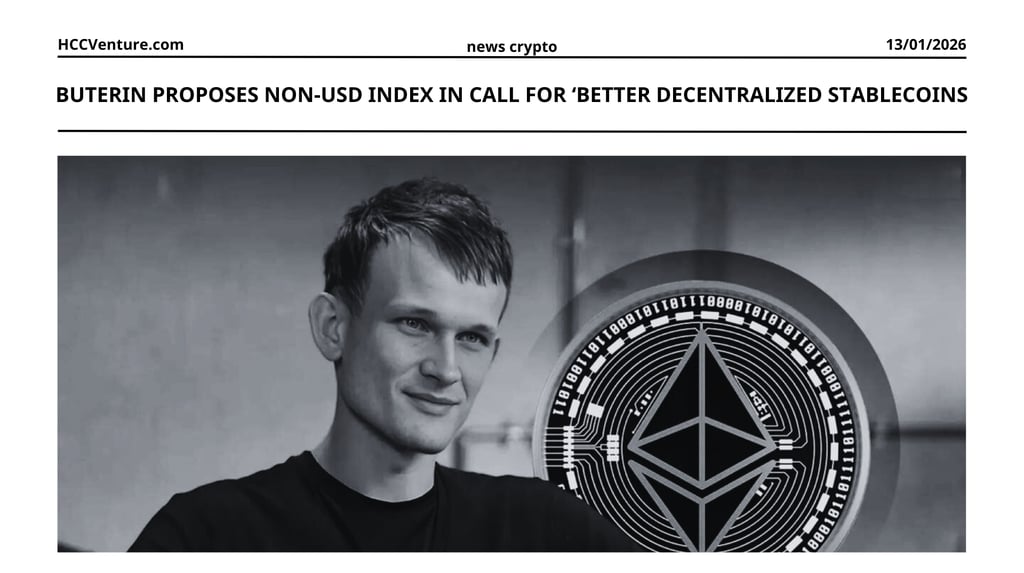
Ethereum co-founder Vitalik Buterin has reignited the long-running debate about stablecoin design, suggesting that the next generation of decentralized stablecoins should move beyond strict pegging to the USD and instead aim for more diversified indicators of real-world assets or currencies.
In a series of posts and comments published on January 12-13, 2026, Buterin argued that over-reliance on the US dollar creates systemic fragility, risks centralization, and misses opportunities for a truly global, censorship-resistant currency.
His core argument: “ We need better decentralized stablecoins — stablecoins that are not just USD shells with more complex mechanisms. A more robust design would track a diversified basket (global inflation index, commodity basket, or even a composite 'world GDP' index) instead of being 100% tied to a single fiat currency. This would make them more resilient to monetary policy swings of any country and more suitable for a truly borderless economy .”
What is a non-USD index?
Buterin didn't offer a specific design, but several possible approaches emerged from his comments and community discussions:
1. Anchoring based on the basket of goods.
Track a weighted index of gold, oil, copper, agricultural commodities, etc.
Advantages: Protects against inflation, has little correlation with any fiat currency.
Disadvantages: Complexity of the oracle system, volatility of the price of the underlying assets.
2. CPI/Global Inflation Index
Neo is based on a composite “world consumer price index” (a weighted average of major economies).
Advantages: Protects purchasing power globally.
Disadvantage: Requires decentralized, reliable oracle systems for multinational CPI data.
3. Currency basket (similar to SDR)
Simulating the IMF's Special Drawing Rights (SDR) but on a blockchain (USD + EUR + CNY + JPY + GBP, or adding emerging markets).
Advantages: Diversifies exposure to fiat currency.
Disadvantages: Still partially dependent on the USD; political sensitivity surrounding the CNY weighting.
4. Composite World GDP Index
The most ambitious goal: a decentralized index reflecting global economic output (estimated through on-chain activity, satellite data, trade flows, etc.).
Advantages: Truly global, neutral standards.
Disadvantage: Extremely difficult to build precisely and in a decentralized manner.
Why is this important?
Buterin's timing is noteworthy. As governments tighten regulation of stablecoins, USD-backed issuers could become an extension of national fiscal policy. Meanwhile, stablecoins are increasingly used outside the United States, often in regions with limited access to dollars or differing economic priorities.
A non-USD index stablecoin could provide a neutral payment unit for global DeFi, easing regulatory bottlenecks and offering resilience against unilateral policy shocks.
In other words, it's a risk hedging measure—not against volatility, but against monetary concentration.
Our review
Vitalik Buterin's latest intervention isn't a criticism of existing USD stablecoins, but rather a push toward a more mature ecosystem. By advocating for diversified, non-index-based USD designs, he reminds developers that true decentralization requires moving beyond dependence on any single country's monetary system.
Whether the next groundbreaking decentralized stablecoin will be commodity-backed, linked to the consumer price index (CPI), or something entirely new remains to be seen. But Buterin's words carry weight: when the Ethereum co-founder says it's time to build "better decentralized stablecoins," the community—and the market—usually listens.
Disclaimer: The information presented in this article is the author's personal opinion in the field of cryptocurrency. This is not financial or investment advice. All investment decisions should be based on careful consideration of your personal portfolio and risk tolerance. The views expressed in this article do not represent the official stance of the platform. We recommend that readers conduct their own research and consult with experts before making any investment decisions.
Compiled and analyzed by HCCVenture
Follow HCCVenture here: https://link3.to/holdcoincventure
Explore HCCVenture group
HCCVENTURE QUANT JSCO
© 2026 HCCVENTURE. ALL COPYRIGHTS RESERVED.


Connect with us
Popular content
Contact to us
Address: 8th Floor, Bach Dang Complex Building, 50 Bach Dang Street, Hai Chau Ward, Da Nang City, Vietnam.
Phone: 1900 1509
Gmail : sp_contact@hccventure.com
Disclaimer: The information on this website is for informational purposes only and should not be considered investment advice. We are not responsible for any risks or losses arising from investment decisions based on the content here.
TERMS AND CONDITIONS • CUSTOMER PROTECTION POLICY
ANALYTICAL AND NEWS CONTENT IS COMPILED AND PROVIDED BY EXPERTS IN THE FIELD OF DIGITAL FINANCE AND BLOCKCHAIN BELONGING TO HCCVENTURE ORGANIZATION, INCLUDING OWNERSHIP OF THE CONTENT.
RESPONSIBLE FOR MANAGING ALL CONTENT AND ANALYSIS: HCCVENTURE FOUNDER - TRUONG MINH HUY
Read warnings about scams and phishing emails — REPORT A PROBLEM WITH OUR SITE.