

BMIC presents evidence showing risks to crypto wallets
According to BMIC, most cryptocurrency wallets currently in use were never designed to cope with quantum adversaries, leaving long-term digital asset security vulnerable to cryptographic attacks.
1/8/20262 min read
A quantum-resistant digital wallet ecosystem
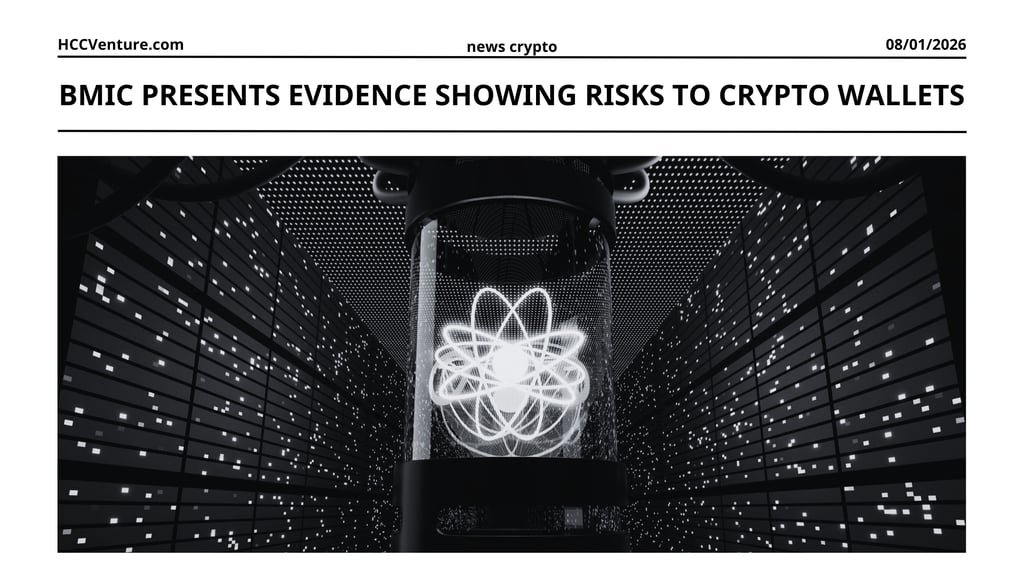
MIC (Blockchain Micro-Ion Compute) positions itself as one of the most proactive solutions to this long-term threat. BMIC is building a comprehensive ecosystem focused on post-quantum security from the ground up – starting with a next-generation digital wallet designed for the quantum age.
The following warnings were issued in the BMIC report regarding anti-quantum measures:
Smart accounts with hidden signatures – Transactions are routed without revealing the classic on-chain public key, minimizing the "collect first, decrypt later" risk often associated with traditional e-wallets.
Hybrid post-quantum cryptography – Combining NIST-approved network-based algorithms (e.g., Dilithium) with existing ECDSA for backward compatibility while providing two-layer defense against quantum attacks.
Modular architecture – Allows for seamless updates of cryptographic algorithms over time without forcing users to make disruptive switches – a key advantage for long-term holders and organizations.
Unified design based on quantum principles — Storage, staking/profit generation, and payments all operate within the same post-quantum framework, eliminating weak links between layers.
AI-powered monitoring — Real-time threat detection, anomaly flagging, and performance optimization to stay ahead of evolving risks.
Broader ecosystem vision — Expanding to Quantum Security as a Service (QSaaS) for enterprises, Quantum Hypercloud (decentralized access to quantum hardware), and anti-quantum staking/payment layers.
BMIC's approach differs from traditional wallets that retroactively patch anti-quantum vulnerabilities. By designing from a quantum foundation, BMIC aims to completely eliminate public key exposure and support smooth adaptability as post-quantum standards evolve.
Why is quantum risk no longer just a theory ?
Quantum computers threaten public-key cryptography through algorithms such as the Shor algorithm, which could theoretically break widely used schemes like ECDSA and RSA. These schemes are the foundation of most cryptocurrency wallets today, securing private keys, signatures, and transaction authorization.
While large-scale quantum attacks are not yet feasible, BMIC underscores a crucial concept: “collect data now, decrypt later.” An adversary could record encrypted data today and wait until quantum capabilities mature to exploit it retrospectively. For blockchain, this means exposed public keys and long-lasting addresses that could become a future threat.
Risk assessment or mere speculation ?
This timing seems very clear. Recent news—from Coinbase analysts warning of broader quantum implications to projects like qLABS announcing quantum signature wrappers—has drawn renewed attention to post-quantum readiness. While no credible expert predicts Bitcoin will be disrupted by quantum technology by 2026 (current machines lack scale and stability), the risk of "immediate harvest" is already present, and legacy addresses (especially those reused or inactive) remain vulnerable.
BMIC targets long-term holders, institutions, and developers who prioritize regulatory-level custody and security over short-term speculation. Risks remain: pre-selling is inherently speculative, quantum threats are still a distant prospect, and competition in the post-quantum cryptocurrency space is increasing (e.g., QRL, SEALSQ hardware solutions). Success will depend on execution capabilities—providing a secure, user-friendly, and scalable digital wallet.
Disclaimer: The information presented in this article is the author's personal opinion in the field of cryptocurrency. This is not financial or investment advice. All investment decisions should be based on careful consideration of your personal portfolio and risk tolerance. The views expressed in this article do not represent the official stance of the platform. We recommend that readers conduct their own research and consult with experts before making any investment decisions.
Compiled and analyzed by HCCVenture
Follow HCCVenture here: https://link3.to/holdcoincventure
Explore HCCVenture group
HCCVENTURE QUANT JSCO
© 2026 HCCVENTURE. ALL COPYRIGHTS RESERVED.


Connect with us
Popular content
Contact to us
Address: 8th Floor, Bach Dang Complex Building, 50 Bach Dang Street, Hai Chau Ward, Da Nang City, Vietnam.
Phone: 1900 1509
Gmail : sp_contact@hccventure.com
Disclaimer: The information on this website is for informational purposes only and should not be considered investment advice. We are not responsible for any risks or losses arising from investment decisions based on the content here.
TERMS AND CONDITIONS • CUSTOMER PROTECTION POLICY
ANALYTICAL AND NEWS CONTENT IS COMPILED AND PROVIDED BY EXPERTS IN THE FIELD OF DIGITAL FINANCE AND BLOCKCHAIN BELONGING TO HCCVENTURE ORGANIZATION, INCLUDING OWNERSHIP OF THE CONTENT.
RESPONSIBLE FOR MANAGING ALL CONTENT AND ANALYSIS: HCCVENTURE FOUNDER - TRUONG MINH HUY
Read warnings about scams and phishing emails — REPORT A PROBLEM WITH OUR SITE.