


BitMine stakes over $200 million worth of Ethereum
BitMine deposited 74,880 ETH into Ethereum's Proof-of-Stake (PoS) system, worth approximately $219 million USD at the current price of around $2,927/ETH on December 27th.
12/28/20252 min read
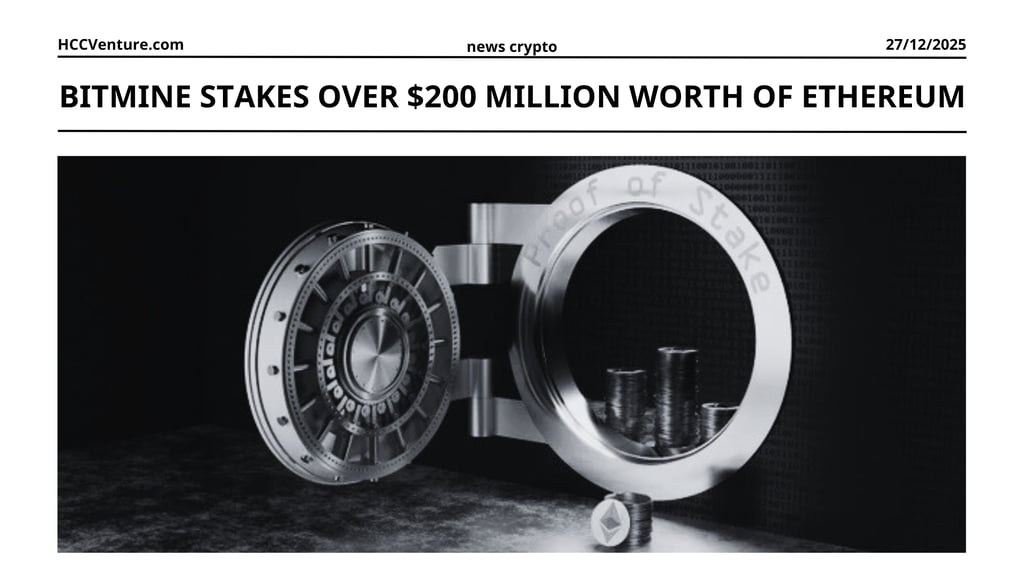
Rebuilding a digital portfolio
Multiple coordinated transfers have directly channeled 74,880 ETH into Ethereum validator deposit contracts (commonly known as " BatchDeposit "). This represents BitMine's first staking activity after years of passive holding. While this deposit amount is relatively modest compared to the company's total treasury, it is clear evidence of its scalability.
BitMine controls approximately 4.066 million ETH , equivalent to about 3.37% of the total Ethereum supply and valued at around $11.9 billion (based on recent prices).
The annual yield (APY) from Ethereum staking is currently around 3.12% . If BitMine staked all of its holdings, it could generate approximately 126,800 ETH per year — equivalent to about $371 million in rewards at current prices.
The initial investment of $219 million alone could yield over 2,300 ETH annually ( $6.7 million ), providing a hedge against price volatility without having to sell the underlying asset.
Why is staking important?
Ethereum staking transforms idle ETH into a yielding asset, secured by the network's proof-of-stake consensus mechanism . For large investors, this offers several advantages over simply holding ETH on their balance sheet.
Generate direct returns using ETH, without relying on leverage or counterparty risk often found in DeFi lending markets. Directly link stakers to the stability and security of the Ethereum network, reinforcing long-term commitment rather than short-term trading.
For organizations like BitMine, staking is a disciplined way to extract value from holding ETH long-term.
Scale reflects confidence.
Depositing over $200 million worth of ETH is not an experiment. At this scale, BitMine is making a structural bet on the longevity, security model, and economic sustainability of Ethereum.
Large-scale staking requires robust operational infrastructure, validator management, risk control, and compliance processes. This move implies that BitMine has built or partnered to operate institutional-level staking operations—a far cry from the retail staking setups that dominated Ethereum's early proof-of-stake era.
This level of deployment sends a clear signal to the market: Ethereum staking is now seen as an institutionally viable core infrastructure, rather than a small-scale cryptocurrency operation.
Our review perspective
BitMine's decision to invest over $200 million in Ethereum marks a significant milestone in the institutionalization of on-chain returns. This underscores Ethereum's maturation from a speculative asset into an efficient financial infrastructure capable of supporting large-scale capital deployments.
As more and more organizations follow this path, staking is likely to become a key feature in how businesses hold, value, and integrate Ethereum into their treasuries — solidifying ETH's central role in the digital asset economy.
Disclaimer: The information presented in this article is the author's personal opinion in the field of cryptocurrency. This is not financial or investment advice. All investment decisions should be based on careful consideration of your personal portfolio and risk tolerance. The views expressed in this article do not represent the official stance of the platform. We recommend that readers conduct their own research and consult with experts before making any investment decisions.
Compiled and analyzed by HCCVenture
Follow HCCVenture here: https://link3.to/holdcoincventure
Explore HCCVenture group
HCCVENTURE QUANT JSCO
© 2026 HCCVENTURE. ALL COPYRIGHTS RESERVED.


Connect with us
Popular content
Contact to us
Address: 8th Floor, Bach Dang Complex Building, 50 Bach Dang Street, Hai Chau Ward, Da Nang City, Vietnam.
Phone: 1900 1509
Gmail : sp_contact@hccventure.com
Disclaimer: The information on this website is for informational purposes only and should not be considered investment advice. We are not responsible for any risks or losses arising from investment decisions based on the content here.
TERMS AND CONDITIONS • CUSTOMER PROTECTION POLICY
ANALYTICAL AND NEWS CONTENT IS COMPILED AND PROVIDED BY EXPERTS IN THE FIELD OF DIGITAL FINANCE AND BLOCKCHAIN BELONGING TO HCCVENTURE ORGANIZATION, INCLUDING OWNERSHIP OF THE CONTENT.
RESPONSIBLE FOR MANAGING ALL CONTENT AND ANALYSIS: HCCVENTURE FOUNDER - TRUONG MINH HUY
Read warnings about scams and phishing emails — REPORT A PROBLEM WITH OUR SITE.