

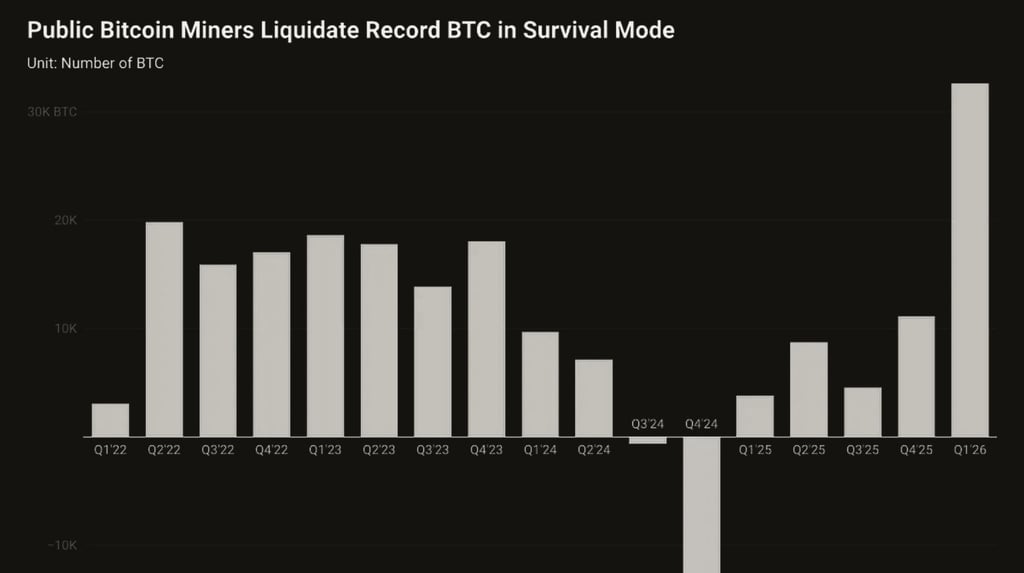
Bitcoin miners sold a record 32,000 BTC in Q1 2026
According to data compiled by TheEnergyMag and reported by multiple sources, publicly listed Bitcoin mining companies sold a record amount of Bitcoin, more than 32,000 BTC, in the first quarter of 2026.
4/17/20263 min read
Miners are back after a period of stagnation
According to recent reports, publicly listed Bitcoin miners sold a record 32,000 BTC in Q1 2026, signaling a notable shift in behavior from long-term accumulation to aggressive distribution and liquidity management.
In previous cycles, many miners adopted a "hold" strategy, retaining mined Bitcoin to wait for higher prices. That model is now facing difficulties.
Rising energy costs, tighter financial conditions, and a drop in revenue following the halving event have forced miners to prioritize cash flow over accumulation. Selling Bitcoin has become less strategic and more of a survival necessity.
Reasons for the record liquidation
Revenue per hash rate unit has dropped to around $33/PH/second, below the break-even point for many operators with higher costs (estimated at around $35 or more). Approximately 20% of the network is believed to be operating at a loss.
The April 2024 halving event reduced block rewards, while the network's hash rate continued to increase, intensifying competition and narrowing profit margins. Energy costs, debt repayments, and investments in new equipment put pressure on balance sheets, forcing miners to monetize their BTC holdings rather than holding ( HODL ).
Several companies are shifting capital to artificial intelligence (AI) and high-performance computing ( HPC ) infrastructure . Core Scientific and others have explicitly stated plans to sell Bitcoin vaults to fund these transitions, accelerating the pace of liquidation.
This wave of selling is in stark contrast to River's Q1 ownership data, which showed businesses (+69,000 BTC ) and governments (+25,000 BTC ) as net accumulators, offsetting net selling by individual investors ( -62,000 BTC ). The miners' selling appears to have been absorbed by stronger holders without causing a significant price drop.
The economics of the mining industry are reshaping behavior
The economics of the mining industry have changed significantly. With declining block rewards and increased competition, miners are operating with thinner profit margins. At the same time, access to cheap capital is no longer as abundant as it once was. This combination creates a feedback loop:
Lower profit margins → increased demand for sales
Sell more → reduce inventory
Decreased inventories → increased sensitivity to price fluctuations
In this environment, miners shift from long-term holders to continuous sellers. The large-scale selling by miners creates a significant supply surge in the market. While 32,000 BTC is a modest number compared to the total circulating supply, it represents a significant increase in selling pressure, especially when concentrated over a short period.
Supply pressure versus absorption capacity of organizations
Large mining companies typically sell through decentralized exchanges or in small batches to minimize market impact and limit immediate downward pressure on spot prices.
Not all mining companies are created equal. Operators with higher efficiency or lower costs (and those that have successfully transitioned to AI) are better positioned, while smaller companies face the risk of capitulation or merger.
The continued growth of hashrate despite the sell-off demonstrates strong network security, but it also maintains profit margin pressure until Bitcoin's price or efficiency improvements bring about relief.
This news adds to the cautious short-term narrative but is overshadowed by positive developments regarding Ethereum's robust on-chain operational structure, corporate treasury accumulation (Strategy's BTC purchases, BitMine's ETH purchases), and the maturing RWA/tokenization channels.
Our review
The record sell-off of mining equipment in Q1 2026 indicates an ongoing adjustment following the Bitcoin mining industry's halving event. While this creates difficulties for high-cost operators, the liquidation provides liquidity to the market and allows capital to flow toward more efficient miners or more diversified business models (AI/HPC).
In a maturing Bitcoin ecosystem, large-scale sell-offs of mining equipment are nothing new, but the speed and volume in Q1 2026 underscore the industry's current challenges. As long as demand from institutions and governments remains strong, this supply is likely to be absorbed rather than trigger a deep correction. The mining industry is undergoing a Darwinian evolutionary restructuring: only the strongest (or most diverse) will thrive.
Disclaimer: The information presented in this article is the author's personal opinion in the field of cryptocurrency. This is not financial or investment advice. All investment decisions should be based on careful consideration of your personal portfolio and risk tolerance. The views expressed in this article do not represent the official stance of the platform. We recommend that readers conduct their own research and consult with experts before making any investment decisions.
Compiled and analyzed by HCCVenture
Follow HCCVenture here: https://link3.to/holdcoincventure
Explore HCCVenture group
HCCVENTURE QUANT JSCO
© 2026 HCCVENTURE. ALL COPYRIGHTS RESERVED.


Connect with us
Popular content
Contact to us
Address: 8th Floor, Bach Dang Complex Building, 50 Bach Dang Street, Hai Chau Ward, Da Nang City, Vietnam.
Phone: 1900 1509
Gmail : sp_contact@hccventure.com
Disclaimer: The information on this website is for informational purposes only and should not be considered investment advice. We are not responsible for any risks or losses arising from investment decisions based on the content here.
TERMS AND CONDITIONS • CUSTOMER PROTECTION POLICY
ANALYTICAL AND NEWS CONTENT IS COMPILED AND PROVIDED BY EXPERTS IN THE FIELD OF DIGITAL FINANCE AND BLOCKCHAIN BELONGING TO HCCVENTURE ORGANIZATION, INCLUDING OWNERSHIP OF THE CONTENT.
RESPONSIBLE FOR MANAGING ALL CONTENT AND ANALYSIS: HCCVENTURE FOUNDER - TRUONG MINH HUY
Read warnings about scams and phishing emails — REPORT A PROBLEM WITH OUR SITE.