
Base Layer-2 will abandon Optimism and move towards a unified infrastructure operating system
According to reports, Base, the Ethereum Layer-2 network incubated by Coinbase, is preparing to abandon its reliance on the Optimism platform and move to a unified technology platform operated by Base itself.
3/1/20263 min read
Network migration announcement from CoinBase
Coinbase's Ethereum Layer-2 network, Base, has announced a strategic shift in the coming months, moving away from its over-reliance on the Optimism OP Stack— the open-source software framework that supported its 2023 launch—and adopting a unified software stack , operated by Base (referred to as " base/base ").
This move, detailed in a February 18, 2026 blog post from Base's engineering team, aims to accelerate innovation, reduce coordination costs, and enable faster upgrades while consolidating core components into a single open-source codebase.
Base, with its total value locked (TVL) having grown to approximately $3.8–$3.85 billion and ranking among the most dynamic Ethereum scaling solutions , emphasizes that this shift enhances autonomy without completely severing ties with Optimism .
The network will continue to collaborate as an OP Enterprise client to support critical missions, maintain compatibility with existing OP Stack specifications during the transition, and maintain interoperability with the broader Superchain ecosystem.
Key aspects of the transition process
The rollout will be in multiple phases over several months, with no immediate impact on users or developers. Node operators will eventually migrate to the new Base client to maintain compatibility with upcoming hard forks (including Base V1).
Technical changes: Unified source code (base/base on GitHub) unifies the sequencer, client releases, and dependencies (built on open-source components like Reth).
Goal: A maximum of six hard forks per year (double the previous rate) for more frequent, narrower upgrades.
Future upgrades: Development of the proof-of-concept system (from optimistic proof to TEE/ZK proof for faster validation), support for Ethereum Fusaka, and enhanced security/governance (dedicated security council signatories for Base and fee mechanism).
Base was initially launched on the OP Stack to quickly reach market but accumulated many different dependencies ( Optimism, Flashbots, Paradigm ). The consolidation reduced complexity, increased deployment speed, and optimized Base for its specific use case—making it scalable to 1 gigagas/s and beyond.
Base remains within the Superchain framework but operates more independently — no longer sharing decoder revenue with Optimism Collective as before.
Strategic autonomy versus ecosystem cooperation
Optimism's Superchain vision focuses on interoperability between OP Stack chains, creating a unified security and governance framework. If Base deviates from that common framework, it could signal:
Desire for vertical integration
Competitive positioning among L2s
Reduce interdependence in governance.
Brand differentiation at the infrastructure level.
For Coinbase, owning the entire ecosystem could lead to tighter integration with exchange services, custody solutions, and consumer products on the chain.
Market reaction and consequences to the OP Token
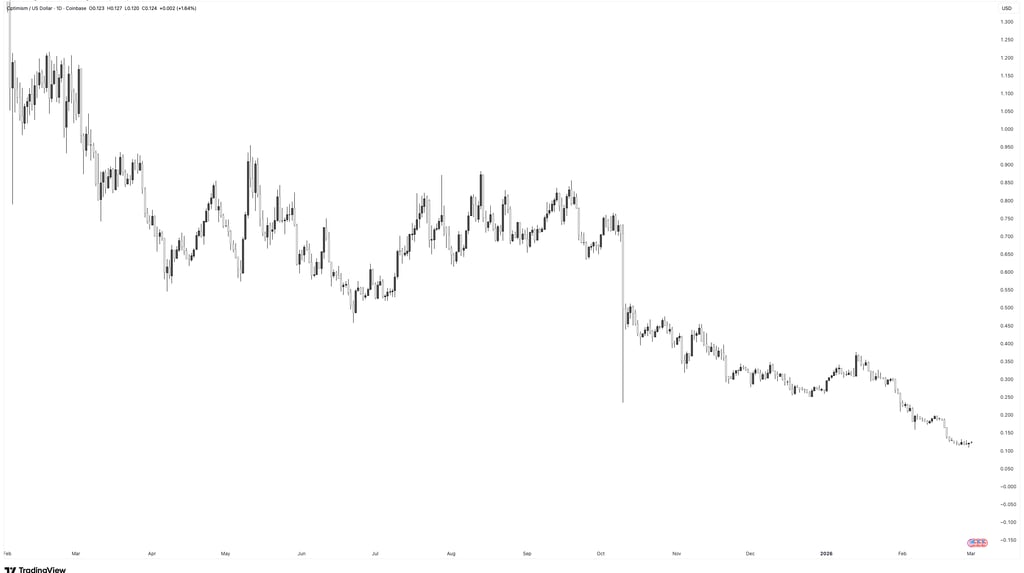
This announcement triggered a sharp sell-off in OP (Optimism's governance token ), dropping 20-26% within 24 hours of the news being released (trading around $0.14 at its lowest point). Base is the highest revenue contributor to the OP Collective (up to 97% in some periods), so reducing revenue sharing from sequencers undermines the Superchain's economic model and raises questions about its long-term sustainability.
There was no major negative price reaction for ETH or Base's underlying assets; this change is seen as a positive signal for Base's long-term viability (faster iteration rates, reduced reliance on external factors).
Superchain dynamics: Analysts note that this tests the revenue-sharing argument—if Base (OP Stack's flagship chain) moves toward independence, it could put pressure on other participants (e.g., Unichain, World Network) and fragment the ecosystem's cohesion.
This reinforces the trend of large L2s seeking greater control (e.g., custom stacks, proof-of-stake upgrades) amid competition from Solana, Avalanche, and emerging modular chains. Coinbase's influence as an incubator for Base underscores the need for vertical integration within cryptocurrency infrastructure.
Our review
Base's transition to a unified, self-operating architecture marks a maturation phase for the network—trading some of the benefits of a shared ecosystem for speed, control, and scalability. While this move briefly disrupted the OP market, it aligns with Coinbase's vision for a more independent, higher-performance L2. As the transition progresses towards mid-2026, expect this to reshape narratives surrounding the Superchain economy and L2 sovereignty in Ethereum's scaling battle.
Disclaimer: The information presented in this article is the author's personal opinion in the field of cryptocurrency. This is not financial or investment advice. All investment decisions should be based on careful consideration of your personal portfolio and risk tolerance. The views expressed in this article do not represent the official stance of the platform. We recommend that readers conduct their own research and consult with experts before making any investment decisions.
Compiled and analyzed by HCCVenture
Follow HCCVenture here: https://link3.to/holdcoincventure
Explore HCCVenture group
HCCVENTURE QUANT JSCO
© 2026 HCCVENTURE. ALL COPYRIGHTS RESERVED.


Connect with us
Popular content
Contact to us
Address: 8th Floor, Bach Dang Complex Building, 50 Bach Dang Street, Hai Chau Ward, Da Nang City, Vietnam.
Phone: 1900 1509
Gmail : sp_contact@hccventure.com
Disclaimer: The information on this website is for informational purposes only and should not be considered investment advice. We are not responsible for any risks or losses arising from investment decisions based on the content here.
TERMS AND CONDITIONS • CUSTOMER PROTECTION POLICY
ANALYTICAL AND NEWS CONTENT IS COMPILED AND PROVIDED BY EXPERTS IN THE FIELD OF DIGITAL FINANCE AND BLOCKCHAIN BELONGING TO HCCVENTURE ORGANIZATION, INCLUDING OWNERSHIP OF THE CONTENT.
RESPONSIBLE FOR MANAGING ALL CONTENT AND ANALYSIS: HCCVENTURE FOUNDER - TRUONG MINH HUY
Read warnings about scams and phishing emails — REPORT A PROBLEM WITH OUR SITE.