
Any country that supplies military weapons to Iran will be subject to a 50% tariff from the United States
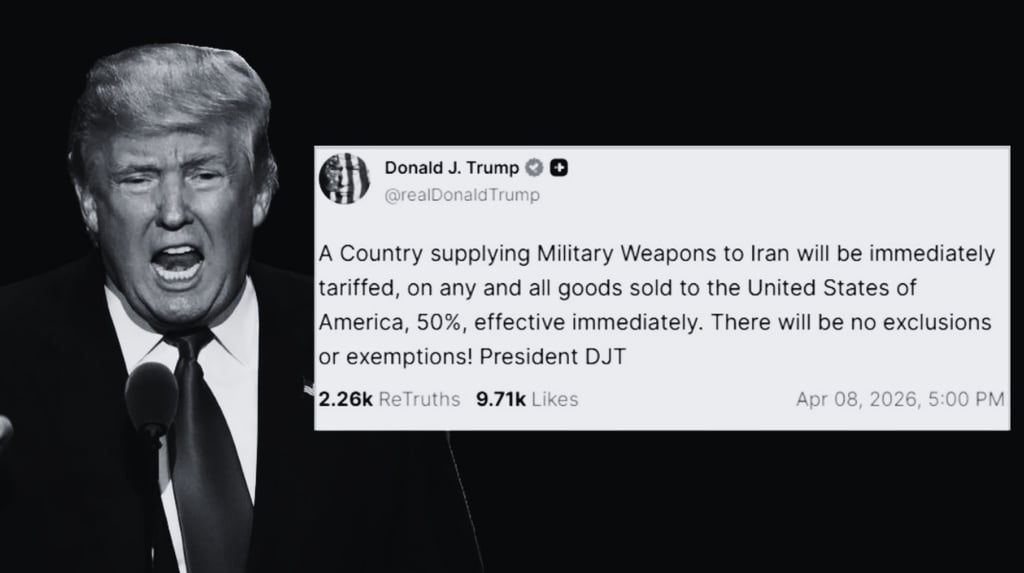
President Donald Trump announced on April 8, 2026, via Truth Social, that any country supplying military weapons to Iran would be subject to an immediate 50% tariff on “all goods.”
4/9/20262 min read
Trade policy as a diplomatic tool
President Donald Trump has declared that any country supplying military weapons to Iran will face an immediate 50% tariff on all goods exported to the United States, without exception. This measure was announced shortly after a temporary ceasefire agreement with Tehran, signaling a shift from direct military pressure to economic deterrence.
Although the statement did not name specific countries, the main suppliers of military equipment and dual-use technology to Iran are well-known:
Russia - Supplying advanced missiles, air defense systems, and drones.
China - Supplies components, dual-use technology, and some complete systems.
North Korea - Providing ballistic missile technology and ammunition.
This statement reflects a familiar pattern in Trump's approach, using tariffs not only as economic tools but also as geopolitical leverage. By targeting third countries instead of directly targeting Iran, this policy provides a secondary mechanism of sanctions through trade.
This expands the scope of pressure beyond bilateral relations. Countries that maintain military ties with Iran now face the direct cost of impaired access to the US market, forcing them to choose between geopolitical alignment and economic risk.
Legal and Structural Constraints
Despite its aggressive tone, this policy still faces legal uncertainty. In early 2026, the U.S. Supreme Court limited Trump's ability to impose broad tariffs under emergency powers, forcing the administration to rely on alternative legal frameworks such as Section 301 or Section 232.
These mechanisms are slower and more targeted, raising questions about whether the tariff threat can be implemented immediately and globally as described. This creates a gap between declaration and execution—a gap that markets and partners will be watching closely.
A signal rather than a shock
The initial market reaction was relatively subdued, particularly compared to the volatility seen during previous periods of escalating tensions in the Middle East. The tariff threat appeared to be interpreted less as an immediate economic shock and more as part of a broader negotiating framework linked to a ceasefire agreement with Iran.
At the same time, this move adds another layer of uncertainty to global trade, especially at a time when supply chains are adjusting to previous tariff regimes and geopolitical fragmentation.
The shift toward economic restraint
This policy highlights a broader strategic shift. Instead of relying solely on sanctions or military action, the U.S. is increasingly using its access to trade as leverage to influence geopolitical behavior.
In practical terms, this blurs the lines between trade policy, national security policy, and diplomatic negotiations. It also reinforces the trend of global trade becoming increasingly conditional, linked not only to economics, but also to alliances within competing geopolitical blocs.
Our review
The threat of a 50% tariff serves two purposes: to deter Iran from further armaments, and to create leverage in ongoing ceasefire and sanctions easing negotiations. Whether this will be implemented formally or merely a rhetorical tool will depend on intelligence assessments, diplomatic progress, and legal avenues in the coming days.
Against the broader backdrop of Trump's second-term trade policies, which already included aggressive tariff measures, this statement further reinforces the intention to use economic access to the US market as a weapon to serve national security objectives. While the ceasefire agreement brought a temporary lull in direct conflict, the economic battleground continues.
Disclaimer: The information presented in this article is the author's personal opinion in the field of cryptocurrency. This is not financial or investment advice. All investment decisions should be based on careful consideration of your personal portfolio and risk tolerance. The views expressed in this article do not represent the official stance of the platform. We recommend that readers conduct their own research and consult with experts before making any investment decisions.
Compiled and analyzed by HCCVenture
Follow HCCVenture here: https://link3.to/holdcoincventure
Explore HCCVenture group
HCCVENTURE QUANT JSCO
© 2026 HCCVENTURE. ALL COPYRIGHTS RESERVED.


Connect with us
Popular content
Contact to us
Address: 8th Floor, Bach Dang Complex Building, 50 Bach Dang Street, Hai Chau Ward, Da Nang City, Vietnam.
Phone: 1900 1509
Gmail : sp_contact@hccventure.com
Disclaimer: The information on this website is for informational purposes only and should not be considered investment advice. We are not responsible for any risks or losses arising from investment decisions based on the content here.
TERMS AND CONDITIONS • CUSTOMER PROTECTION POLICY
ANALYTICAL AND NEWS CONTENT IS COMPILED AND PROVIDED BY EXPERTS IN THE FIELD OF DIGITAL FINANCE AND BLOCKCHAIN BELONGING TO HCCVENTURE ORGANIZATION, INCLUDING OWNERSHIP OF THE CONTENT.
RESPONSIBLE FOR MANAGING ALL CONTENT AND ANALYSIS: HCCVENTURE FOUNDER - TRUONG MINH HUY
Read warnings about scams and phishing emails — REPORT A PROBLEM WITH OUR SITE.