

According to JP Morgan, AI infrastructure will reach $1.4 trillion
JPMorgan has just released a key research report forecasting that global AI infrastructure spending—including data centers, computing hardware (GPU/TPU), and networks—could triple.
1/26/20262 min read


What is AI infrastructure ?
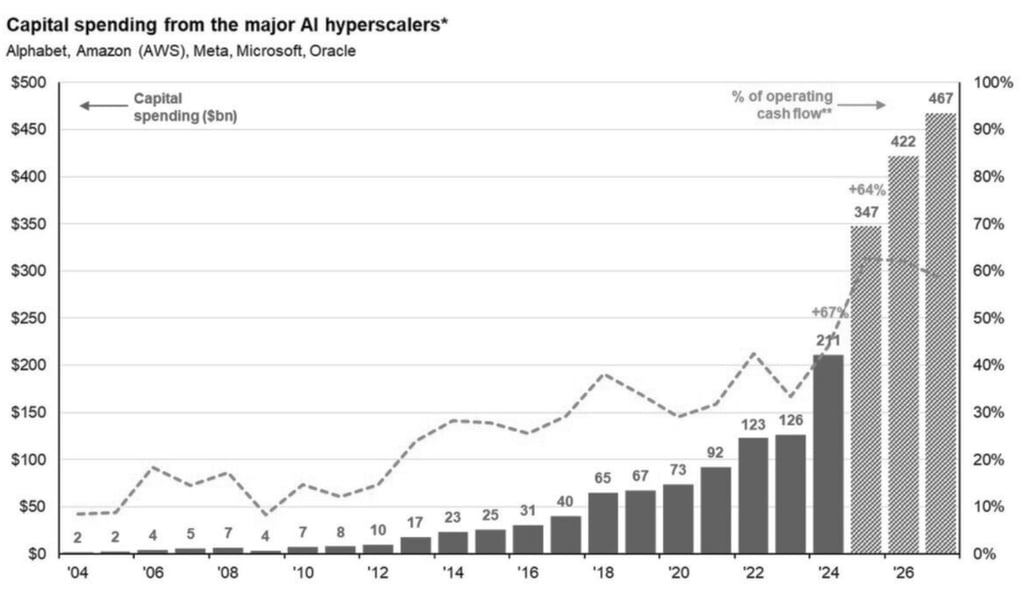
According to JPMorgan Chase's analysis , global spending on AI infrastructure could triple to around $1.4 trillion by 2030 , highlighting the shift of artificial intelligence from a software-based narrative to a capital-intensive industrial build . This forecast places AI alongside energy , transportation , and telecommunications as one of the most important investment cycles of the decade.
JPMorgan's estimate encompasses a vast and rapidly expanding system. At its core are the data centers, advanced semiconductors, networking equipment , and power systems necessary to train and deploy large-scale AI models . Beyond computing, this category also includes cooling, storage, edge infrastructure, and power supply technologies needed to sustain high-density workloads running continuously.
As models grow larger and inference processes become continuous rather than phased, infrastructure requirements will increase exponentially—driving exponential capital investment needs.
Predicted to triple
The bank's argument is based on three mutually reinforcing drivers. Model complexity is rapidly increasing , driving the need for more powerful GPUs , dedicated accelerators, and faster connectivity. AI applications are expanding beyond technology into finance , healthcare , manufacturing, and government —transforming AI from a specialized workload into a versatile utility. Furthermore, competitive pressure is forcing large-scale cloud computing providers and businesses to build overcapacity to avoid being constrained by computing power.
A critical—and often underestimated—component of AI infrastructure is energy. High-density data centers consume enormous amounts of electricity and require stable, low-cost power sources. JPMorgan emphasizes that energy availability could become a binding constraint, reshaping investment toward grid upgrades, on-premise generation, and alternative energy solutions.
Market capitalization impact
The $1.4 trillion investment cycle has had a profound impact on capital allocation. It created years-long growth momentum for semiconductor manufacturers, data center operators, networking companies, and power infrastructure providers. It also favored balance sheets capable of sustaining large initial investments, potentially widening the gap between established companies and smaller competitors.
JPMorgan's perspective also intersects with geopolitics. Governments are beginning to view AI infrastructure as a national strategic capability, similar to energy security or defense manufacturing. This increases the potential for public-private partnerships, subsidies, and policy support—further amplifying the flow of capital into the sector.
Assessment and Conclusion
JPMorgan's projected $1.4 trillion cumulative investment suggests AI infrastructure is one of the largest capital spending cycles in modern history — rivaling the railroad boom, the internet boom, and the shale gas revolution in scale. Even if this figure is 30-40% higher than reality, the trend remains clear: trillions of dollars will pour into computing, energy, and data centers over the next five years.
For investors, this is a multi-year trend with clear winners in the hardware, infrastructure, utility, and — increasingly — decentralized computing networks sectors, all riding the same wave of demand. Bitcoin and Ethereum may benefit indirectly through risk appetite, but the real gains lie with companies and protocols directly supporting the building of energy and AI computing.
Disclaimer: The information presented in this article is the author's personal opinion in the field of cryptocurrency. This is not financial or investment advice. All investment decisions should be based on careful consideration of your personal portfolio and risk tolerance. The views expressed in this article do not represent the official stance of the platform. We recommend that readers conduct their own research and consult with experts before making any investment decisions.
Compiled and analyzed by HCCVenture
Follow HCCVenture here: https://link3.to/holdcoincventure
Explore HCCVenture group
HCCVENTURE QUANT JSCO
© 2026 HCCVENTURE. ALL COPYRIGHTS RESERVED.


Connect with us
Popular content
Contact to us
Address: 8th Floor, Bach Dang Complex Building, 50 Bach Dang Street, Hai Chau Ward, Da Nang City, Vietnam.
Phone: 1900 1509
Gmail : sp_contact@hccventure.com
Disclaimer: The information on this website is for informational purposes only and should not be considered investment advice. We are not responsible for any risks or losses arising from investment decisions based on the content here.
TERMS AND CONDITIONS • CUSTOMER PROTECTION POLICY
ANALYTICAL AND NEWS CONTENT IS COMPILED AND PROVIDED BY EXPERTS IN THE FIELD OF DIGITAL FINANCE AND BLOCKCHAIN BELONGING TO HCCVENTURE ORGANIZATION, INCLUDING OWNERSHIP OF THE CONTENT.
RESPONSIBLE FOR MANAGING ALL CONTENT AND ANALYSIS: HCCVENTURE FOUNDER - TRUONG MINH HUY
Read warnings about scams and phishing emails — REPORT A PROBLEM WITH OUR SITE.