

A veteran of the Satoshi era has transferred 1,000 BTC to two new wallets
A Bitcoin wallet from the Satoshi era has transferred 1,000 BTC (approximately $74.03 million) to two newly created addresses, sparking speculation that a long-inactive holder may be preparing to sell.
4/16/20263 min read
Potential supply sources are starting to be reactivated
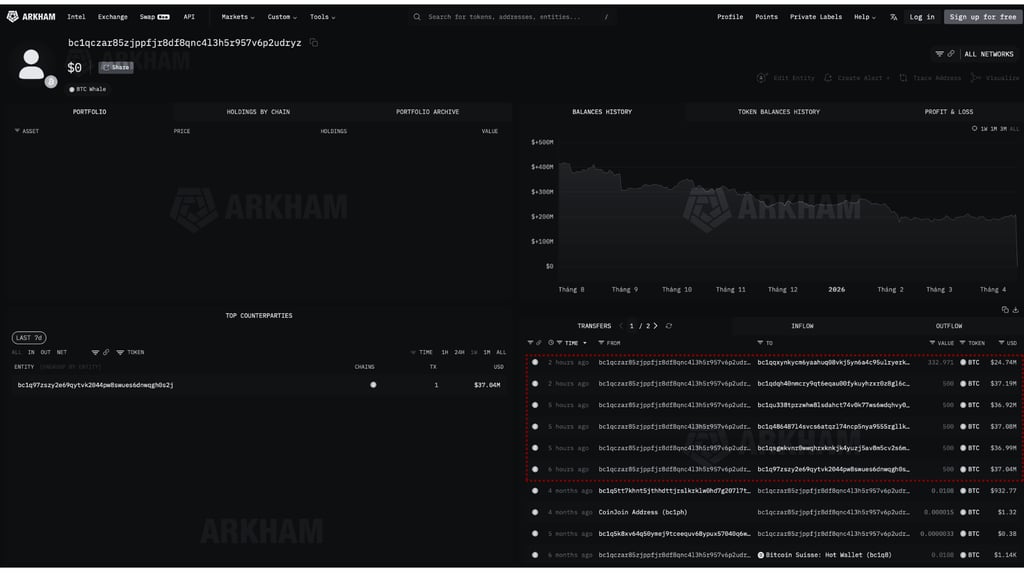
The OG Bitcoin wallet from the Satoshi era has transferred 1,000 BTC (divided into two transactions of 500 BTC each), worth approximately $74.03 million USD, to two newly created wallets in the past hour. This wallet currently holds 1,833 BTC (approximately $135.6 million USD at current prices), suggesting this could be the beginning of a larger distribution rather than a complete withdrawal.
The two most recent withdrawal transactions occurred within the last 30 minutes:
500 BTC (approximately $36.99 million) was sent 3 minutes ago to bc1qsgwkvnr0wwqhrxknkj4k...
500 BTC (approximately $37.04 million) was sent 27 minutes ago to bc1q97zsy2e69qytv2044p...
Both recipient addresses were newly created and had no prior transaction history, a common pattern when large investors prepare for OTC sales or gradually deposit funds into exchanges to minimize market impact.
Digital wallets dating back to the early years of Bitcoin were often associated with long-term trust and minimal activity. When these wallet addresses became active, it typically signaled a shift in behavior rather than conventional portfolio management.
The transfer of 1,000 BTC is noteworthy not only for its scale but also for its origin. Coins that have remained untouched for years represent a portion of the supply that the market typically considers illiquid. When that assumption changes, it introduces new variables into the supply and demand dynamics.
The behavior of the classic Satoshi-era "whale"
Wallets from the early days of Bitcoin (around 2009–2013) often held coins mined or accumulated when BTC was trading at prices ranging from a few cents to a few hundred dollars. These "big players" typically remained quiet for years before resuming activity during bull market peaks or periods of high liquidity.
Recent transfers from this particular wallet follow a familiar pattern seen in other ancient "whales":
Divide your large holdings into smaller, newly created addresses.
Avoid depositing money directly into major exchanges initially (to prevent immediate selling pressure).
Gradual distribution can occur prior to OTC transactions with institutions or market makers.
This move comes amid broader whale activity in 2026, including many dormant wallets awakening after 12–15 years of inactivity. While some big players have shifted to ETH or other assets, many continue to strategically distribute BTC.
Potential supply pressures
Those holding large amounts rarely sell directly on the spot market. The use of the new wallet shows preparation for OTC (over-the-counter) transactions, which can absorb volume without causing significant slippage. With 1,833 BTC still held (~$135.6 million), this wallet still carries a significant level of risk. A full liquidation would require many more transfers of similar size.
The moves during the Satoshi era often generated short-term panic, but historically, they had limited long-term price impact when executed gradually. Current Bitcoin price movements remain more heavily influenced by macroeconomic factors (e.g., Morgan Stanley's comments on the "final phase" of a stock market correction), institutional accumulation (Strategy's continued BTC purchases, BitMine's ETH purchases), and strong on-chain Ethereum indicators.
With current daily trading volumes and strong ETF inflows (including Morgan Stanley's low-fee MSBT), the market could easily absorb over $74 million in OTC inflows without major disruption. Such moves could cause short-term volatility or increased on-chain scrutiny. Traders should monitor subsequent transfers from the same original wallet or deposits from new recipient addresses.
Our review
This reactivation aligns with the pattern of long-term Bitcoin investors rebalancing or realizing profits after years of holding across multiple cycles. The split into two new wallets and the timing of the action suggest more methodical preparation than panic selling.
In the broader context of 2026, with the stabilization of corporate funds, the maturation of tokenized assets (e.g., Ondo's SEC filing progress), and institutional products, the distribution by large individual investors remains part of normal market mechanisms rather than a systemic signal.
Disclaimer: The information presented in this article is the author's personal opinion in the field of cryptocurrency. This is not financial or investment advice. All investment decisions should be based on careful consideration of your personal portfolio and risk tolerance. The views expressed in this article do not represent the official stance of the platform. We recommend that readers conduct their own research and consult with experts before making any investment decisions.
Compiled and analyzed by HCCVenture
Follow HCCVenture here: https://link3.to/holdcoincventure
Explore HCCVenture group
HCCVENTURE QUANT JSCO
© 2026 HCCVENTURE. ALL COPYRIGHTS RESERVED.


Connect with us
Popular content
Contact to us
Address: 8th Floor, Bach Dang Complex Building, 50 Bach Dang Street, Hai Chau Ward, Da Nang City, Vietnam.
Phone: 1900 1509
Gmail : sp_contact@hccventure.com
Disclaimer: The information on this website is for informational purposes only and should not be considered investment advice. We are not responsible for any risks or losses arising from investment decisions based on the content here.
TERMS AND CONDITIONS • CUSTOMER PROTECTION POLICY
ANALYTICAL AND NEWS CONTENT IS COMPILED AND PROVIDED BY EXPERTS IN THE FIELD OF DIGITAL FINANCE AND BLOCKCHAIN BELONGING TO HCCVENTURE ORGANIZATION, INCLUDING OWNERSHIP OF THE CONTENT.
RESPONSIBLE FOR MANAGING ALL CONTENT AND ANALYSIS: HCCVENTURE FOUNDER - TRUONG MINH HUY
Read warnings about scams and phishing emails — REPORT A PROBLEM WITH OUR SITE.