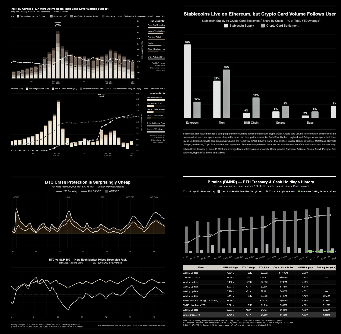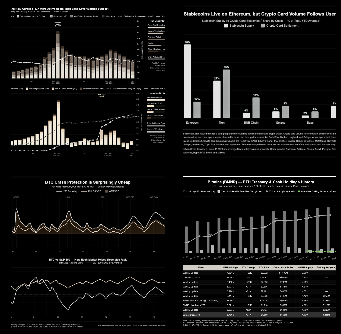


Pumpfun is closing in on Hyperliquid in terms of revenue in the crypto market
Hyperliquid led with $429.04 million, equivalent to 12.62% of the total $3.40 billion tracked across all non-stablecoin projects, and more than the combined revenue of the next two projects.
9/23/20265 min read


Two leading companies are not ranked?
Tether and Circle together generated $5.76 billion during the same period. All the non-stablecoin-issuing projects tracked generated only $3.40 billion. These two companies earned approximately 70% more than all the protocols, launch platforms, exchanges, terminals, wallets, and lending markets in the study combined.
Neither achieved this by building something novel on the chain. Both hold reserves based on circulating stablecoins and earn returns from those reserves. Tether's Q2 report showed $114.96 billion from US Treasury bonds alone, and the company's quarterly operating profit of $1.5 billion came primarily from Treasury bond interest and repurchase agreements. The mechanism is that stablecoin holders do not receive returns while the issuer retains the difference.
That's the actual revenue structure of cryptocurrencies in 2026. The most profitable business is holding government debt based on tokenized dollars. Everything else on the chart is in a far-off second place.
This exclusion is intended for comparison, not to conceal anything, and CoinGecko also excluded Grayscale for the same reason. But that means the chart answers a narrower question than its title suggests: which cryptocurrency-based protocol makes the most money, ignoring the actual dominant business model.
This list mainly consists of speculative projects.
When considering the fifteen names, the pattern is clear. Hyperliquid and edgeX are perpetual futures exchanges. Pump.fun is a memecoin launchpad. Axiom Pro, GMGN, and fomo are trading terminals and applications built for quick token speculation. Collector Crypt encrypts physical collectible cards. Polymarket is a prediction market. Aerodrome is a decentralized exchange. Titan Builder is a MEV block builder that monetizes from arranging transactions rather than from any user-oriented product. Conversely, projects offering something other than speculation are in the minority: Sky and Paxos in the stablecoin and lending sector, Aave in the lending sector, and Phantom is an e-wallet.
The most notable comparison is between Axiom Pro with $132.09 million and GMGN with $126.03 million, each earning more than double the amount earned by Aave ($57 million). Aave is the largest decentralized lending protocol, holding approximately $20 billion in stablecoin deposits and supporting institutional products, including Stable Vaults for fintech integrators. Two trading terminals routing memecoin orders earned more than double as much as it did.
This reverses the assumption that base-layer protocols reap the greatest value. Interfaces between the user and the protocol are reaping more, because attention and command flow are where fees are generated. GMGN appeared in Robinhood Chain data earlier this month as one of two apps driving the chain's fee spike, and FOMO was one of two apps at the heart of the Visa merchant catalog code dispute over buying memecoin and earning credit card rewards. Both are distribution layers, not protocols.
Revenue remained stable while prices fell.
Cryptocurrency revenue averaged $1.08 billion per month through August, even as Bitcoin fell nearly 40% during the same period. This divergence is significant because it contradicts the assumption that the protocol's revenue closely tracks token price. It doesn't track price. It tracks activity, and specifically the intensity of speculation, which can remain high or even increase during a downturn as traders shift to more volatile instruments.
Hyperliquid illustrates this point. The volume of perpetual futures contracts tends to increase with volatility regardless of the direction, because traders using leverage profit from volatility rather than price increases. A bear market with strong liquidation activity generates fee revenue similar to that of a bull market.
The same logic explains why memecoin platforms make up a large portion of this list. Memecoin activity is largely uncorrelated with Bitcoin trends and instead reacts to cycles of attention and new launch mechanisms.
What the chart doesn't take into account
The study only included projects with revenue recognized on the chain, excluding the largest cryptocurrency businesses by revenue other than stablecoin issuers.
Coinbase reported revenue of $1.22 billion in the second quarter of 2026 alone, a figure lower than analysts' forecasts and representing a 19% decrease year-on-year. On an annual basis, Coinbase's revenue far exceeded the total revenue of $3.40 billion tracked across all on-chain projects over the past eight and a half months. Binance, Kraken, Crypto.com, and all other centralized exchanges are not included, as are miners, custodians, and infrastructure providers whose revenue is never recorded on the public ledger.
Additionally, there's a note regarding the definition that needs to be mentioned. Revenue on DefiLlama and similar tracking tools can be either the total fees paid by users or the portion of fees retained by the protocol, and these figures vary significantly for projects that pass the majority of fees to liquidity providers or validators. Comparisons between categories should only be considered approximate.
Sky's inclusion on the list with $129.87 million, along with the exclusion of Tether and Circle, also suggests that the exclusion of this stablecoin was due to scale rather than type, as Sky issues USDS and Paxos operates the stablecoin infrastructure.
Assessment and Conclusion
Hyperliquid's $429 million in revenue is the strongest revenue performance of any cryptocurrency protocol this year, and its cumulative revenue to date has reached approximately $1.26 billion to $1.31 billion, with around 48.7 million HYPE burned. The protocol converts transaction fees into automated HYPE purchases through its Support Fund, directly linking revenue to the token supply.
This token has responded positively. HYPE reached an all-time high of nearly $92 on September 18th, trading around $94 on September 21st with a market capitalization of nearly $20.9 billion, and is up approximately 260% year-to-date while Bitcoin remains far below its October 2025 record high.
At that valuation, the calculation is quite rigorous. Calculating annual revenue of $429 million over eight and a half months yields approximately $606 million, bringing the market capitalization to nearly 35 times revenue. That's a multiple of growth technology applied to a business whose revenue depends on speculative trading volume continuing at its current intensity.
The threat of competition is concrete, not hypothetical. Regulated and centralized exchanges are moving into the perpetual futures market, with the CFTC having approved Kalshi's Bitcoin perpetual contract in May and Coinbase operating Deribit. Hyperliquid's policy division filed a joint opinion with the SEC and CFTC on August 24, arguing that perpetual contracts should be classified by economic structure rather than by the underlying asset, an attempt to shape the rules under which these competitors will operate. Their first-mover advantage in the on-chain perpetual contract space is real, and the period in which they do not face regulated competition is coming to an end.
Disclaimer: The content in this article is for informational, research, data analysis, and reference purposes only regarding the cryptocurrency market. All opinions, assessments, forecasts, or opinions reflect the author's perspective at the time of publication and do not constitute investment advice, solicitations for buying or selling, trading recommendations, advertising, marketing, or promotion of any financial products, services, or cryptocurrencies. Mentions of projects, tokens, protocols, exchanges, wallets, or cryptocurrency service providers (CASPs) are for research, analysis, or informational purposes only and should not be construed as endorsements, recommendations, or guarantees in any way. HCCVenture does not broker, advertise, market, promote, or connect users in Vietnam with any cryptocurrency services from CASPs. HCCVenture does not accept asset custody, investment mandates, manage assets, or execute transactions on behalf of clients. All investment decisions are made entirely through the reader's own research (DYOR), evaluation, and responsibility; HCCVenture is not liable for any losses or damages arising from the use of or reliance on the information presented in this article.
Compiled and analyzed by HCCVenture
Join our information channels: https://link3.to/holdcoincventure
Explore HCCVenture group
HCCVENTURE QUANT JSCO
© 2026 HCCVENTURE. ALL COPYRIGHTS RESERVED.


Connect with us
Popular content
Contact to us
Address: 8th Floor, Bach Dang Complex Building, 50 Bach Dang Street, Hai Chau Ward, Da Nang City, Vietnam.
Phone: 1900 1509
Gmail : sp_contact@hccventure.com
Disclaimer: The information on this website is for informational purposes only and should not be considered investment advice. We are not responsible for any risks or losses arising from investment decisions based on the content here.
TERMS AND CONDITIONS • CUSTOMER PROTECTION POLICY
ANALYTICAL AND NEWS CONTENT IS COMPILED AND PROVIDED BY EXPERTS IN THE FIELD OF DIGITAL FINANCE AND BLOCKCHAIN BELONGING TO HCCVENTURE ORGANIZATION, INCLUDING OWNERSHIP OF THE CONTENT.
RESPONSIBLE FOR MANAGING ALL CONTENT AND ANALYSIS: HCCVENTURE FOUNDER - TRUONG MINH HUY
Read warnings about scams and phishing emails — REPORT A PROBLEM WITH OUR SITE.